In the heart of Karachi once stood enchanting havens of knowledge and literary treasures, cherished by those who sought solace in the scent of aged pages and the wisdom held within. These weren’t mere bookstores; they were sanctuaries run not by mere sellers, but by custodians of literature, individuals who breathed life into the printed word.
Oh, how they adorned the streets, each establishment a beacon of intellect and curiosity. These were not spaces solely for commerce, but sanctuaries where bibliophiles congregated, seeking not just books, but the impassioned guidance of those who lived and breathed literature.
In those bygone days, Karachi wore a different cloak, free from the weight of overcrowded streets and suffocating traffic. The air was not tainted with the metallic tang of modernity; rather, it bore the gentle perfume of nostalgia and simpler times. Evenings unfolded like pages from a cherished novel, each moment infused with the charm of a city at peace with itself.
As I reminisce through the corridors of memory, I’m transported back to those cherished establishments, each one a portal to a different world. There was the cozy nook on a quiet corner, where the proprietor, a sage of sorts, would regale visitors with tales of distant lands and literary marvels. Then, there was the grand emporium with shelves reaching to the heavens, where every tome seemed to whisper secrets of its own.
These were not just places of commerce; they were the beating heart of a community, where the love of literature bound strangers together in a shared reverence for the written word. Alas, as time marches on, these sanctuaries have faded into the annals of history, their absence leaving a void in the fabric of the city’s cultural tapestry.
Yet, through these words, I endeavor to resurrect their memory, if only for a fleeting moment, and to pay homage to the men and women who dedicated their lives to preserving the magic of literature in the bustling streets of Karachi. For in their legacy lies the spirit of a time when the world moved at a gentler pace, and the pursuit of knowledge was not just a pastime, but a way of life.
1. Kitab Mehal
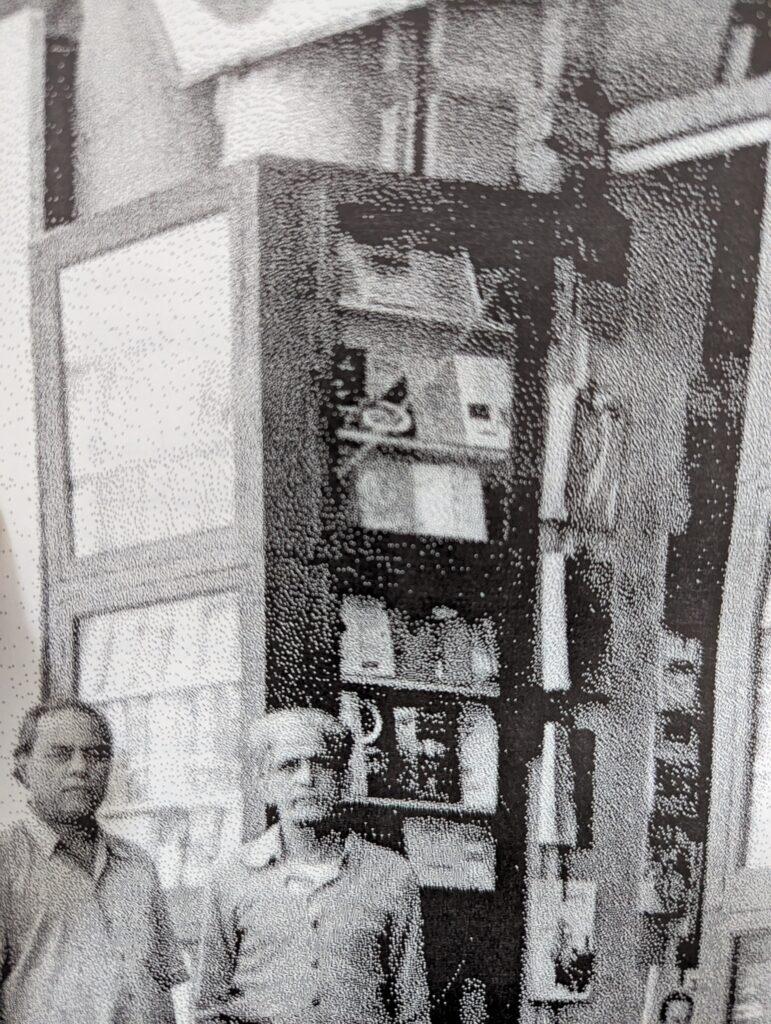
In the annals of memory, Agha Sarkhosh Qizilbash stands as a figure enshrouded in the haze of yesteryears, son of the renowned poet Agha Shair, and sibling to the illustrious broadcaster Sahab Qizilbash. With a mere Rs. 35000 in hand, he breathed life into Kitab Mehal on Elphinstone Street, now a relic lost to the renaming frenzy, forever Zaibunnisa Street.
Agha bhai, or simply the Kitab wala of old, as the whispers of time recall, was more than a mere purveyor of books; he was a custodian of literature’s essence. Before the tumult of partition dragged him to Karachi’s shores, Agha bhai nurtured Chamnistan, a poetry haven nestled in the heart of Delhi. Within its walls, Urdu luminaries like Mijaz and Faiz found solace, while Ismat (aapa) Chughtai graced its threshold with her presence.
The transition from the bustling alleys of Delhi to the humble abode on Burns Road in Karachi marked a stark shift in Agha bhai’s existence. Yet, amidst the two-roomed simplicity, he birthed Norang, a literary beacon that flickered from 1952 to 1964, illuminating minds hungry for the written word.
Kitab Mehal transcended its physicality; it was an institution where bibliophiles congregated to commune with Agha bhai, their patriarch of prose. With paternal affection, he would unveil treasures from distant lands, treating each visitor as kin – both book and reader alike.
But fate, cruel and unrelenting, cast its shadow over this haven of intellect. When Seth Abid’s henchman, Gullu (Machera) dada, unleashed his fury, drenching the sanctuary in water and entombing it in cement and sand, Agha bhai’s spirit crumbled. Only the intervention of Usmani sahab, Karachi’s mayor at the time, staved off the inevitable, if only temporarily. The impassioned pleas of Ahmed Nadeem Qasmi and Jamil Uddin Aali echoed in the pages of newspapers, a futile attempt to halt the juggernaut of Seth’s greed.
In the end, as the relentless pressure to relinquish the property mounted and Agha bhai’s heart faltered, he surrendered, a broken soul, for a trifling sum of 3 lakh Rupees.
With the shuttering of Kitab Mehal, a chapter closed not just in the saga of a bookstore but in the very soul of the city. None could replicate its ethereal charm or the boundless affection of Agha bhai, leaving behind a void that time will never fill.